Engineering takeaway: PPWR should be treated as a design input at project kickoff, not as a compliance check after the package has already been engineered, decorated and qualified.
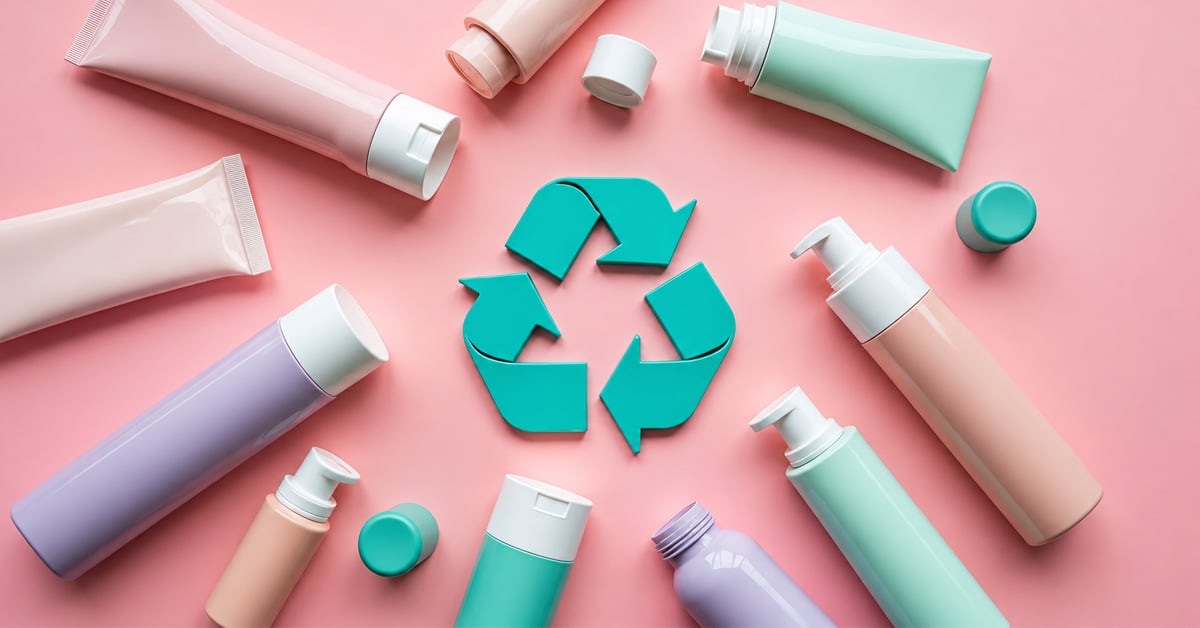
For beauty brands, designing packaging to be recyclable and claiming that packaging is recyclable are no longer the same thing.
California Senate Bill 343, commonly called the “Truth in Recycling” or “Truth in Labeling” law, establishes criteria for determining when a product or package may display the chasing-arrows symbol or another statement indicating that it is recyclable.
From an engineering perspective, this changes the conversation from “What resin is the bottle?” to “Can the complete package be collected, sorted and processed through the recycling system?”
That distinction is especially important for cosmetic and skincare packaging, where a package may combine a bottle, pump, actuator, closure, spring, dip tube, label, adhesive and decorative finish.
What SB 343 Does and Does Not Do
SB 343 does not prohibit a brand from selling packaging that is not recyclable. Instead, it restricts the use of recyclability symbols and statements unless the product or package meets California’s applicable criteria.

These representations may include:
- The chasing-arrows recycling symbol
- The word “recyclable”
- Statements such as “please recycle”
- Other symbols or language that communicate recyclability to consumers
CalRecycle explains that manufacturers and other responsible parties must evaluate whether their products meet the statutory criteria. CalRecycle provides data about material collection and processing, but it does not make product-by-product determinations or approve individual recycling claims. CalRecycle: SB 343 Accurate Recycling Labels
This means that a resin identification code, or the fact that a package is made primarily from PET, HDPE or PP, is not enough by itself to support a recyclability claim.
The Current Implementation Status
CalRecycle published its final 2023–2024 Material Characterization Study on April 4, 2025. Based on that publication date, the 18-month grace period for products and packaging manufactured after the study is scheduled to end on October 4, 2026.
The date is based on when the product or packaging is manufactured, not when it is sold. Packaging manufactured before October 4, 2026, is not subject to the new labeling restrictions, regardless of when it enters the market.
However, the implementation landscape is currently unsettled. On July 14, 2026, a federal court issued a preliminary injunction blocking enforcement of SB 343 while litigation continues. CalRecycle notes that the injunction affects enforcement but does not eliminate the agency’s obligation to update its material-characterization study in 2027 and every five years thereafter. CalRecycle’s current implementation guidance
A preliminary injunction is not the same as a repeal. Beauty brands should continue reviewing their packaging and environmental claims while monitoring the litigation with qualified legal counsel.
Recyclability Is Evaluated Beyond the Primary Resin
One of the most important engineering lessons from SB 343 is that a package should be evaluated by its material type, form and complete design.
To qualify as recyclable through the standard pathway, a product or package generally must satisfy criteria related to:
- Collection access
- Sorting and processing
- Reclamation
- Package composition and design
According to CalRecycle’s FAQ, the material must be accepted by recycling programs collectively serving at least 60% of California’s population. It must also be sorted into defined streams by large-volume transfer or processing facilities that collectively serve at least 60% of statewide recycling programs. Additional composition and design limitations apply. CalRecycle SB 343 FAQ
For a packaging engineer, this means analyzing the entire package, not only the largest component.
A PET bottle, for example, may be made from a commonly collected resin, but the complete package may include features that affect sorting or recycling performance:
- A pump containing multiple plastic resins
- A metal spring or ball
- A full-body shrink sleeve
- A label or adhesive that does not separate during processing
- A dark colorant that affects optical sorting
- An incompatible closure or liner
- A barrier layer or coating
- A decorative metallized finish
- Components that are too small to be effectively sorted
The package must be evaluated as a system.
Why Cosmetic Packaging Requires Special Attention
Beauty packaging is often engineered to protect sophisticated formulas, provide controlled dispensing and deliver a premium consumer experience. These performance requirements can lead to complicated constructions.
Pumps and airless systems
A pump may contain an actuator, housing, spring, ball, gasket, piston and dip tube. An airless system may add a piston, pouch or other internal mechanism.
Even when the bottle is made from PET, PE or PP, the dispensing system may introduce incompatible materials or components that are difficult to separate.
Brands should review:
- The resin used for each plastic component
- Whether a metal spring is present
- Whether components separate during recycling
- The size and shape of the complete package
- Whether a mono-material or metal-free dispensing option is available
Tubes
Tubes may be made from a single plastic or from laminated structures containing multiple layers. Barrier layers can be important for formula protection, but they can also affect compatibility with established recycling streams.
The evaluation should include the tube sleeve, shoulder, cap, orifice reducer, decoration and any barrier structure, not simply the material identified for the outer layer.
Jars and closures
A jar may combine a plastic or glass body with an inner cup, cap, liner, disk, seal or applicator. These components may differ significantly in material and recyclability.
Refillable jars require an additional assessment. A refill system can reduce packaging consumption when it is designed and used effectively, but “refillable” and “recyclable” are separate attributes. Neither claim should automatically be used as evidence for the other.
Labels, sleeves and decoration
Decoration is part of the package design and should be considered early.
A material-compatible bottle can be affected by:
- Label substrate
- Label coverage
- Adhesive selection
- Printing inks
- Metallization
- Foils
- Coatings
- Colorants
- Full-body sleeves
Waiting until the decoration stage to evaluate recyclability can result in expensive redesigns, obsolete artwork or unsupported claims.
An Engineering Review Should Start With the Complete Bill of Materials
Beauty brands should maintain a detailed packaging bill of materials for each SKU. The documentation should identify more than the bottle or jar resin.
A useful engineering review should include:
|
Package element |
Information to document (Show Image & Package Element Name) |
|
Primary container |
Resin, color, weight, capacity and manufacturing process |
|
Pump or dispenser |
Housing, actuator, piston, spring, ball, gasket and dip-tube materials |
|
Closure |
Resin, liner, seal and tamper-evident features |
|
Label or sleeve |
Substrate, adhesive, coverage and separation behavior |
|
Decoration |
Inks, coatings, foils, metallization and colorants |
|
Refill components |
Refill material, attachment method and replacement frequency |
|
Secondary components |
Spatulas, applicators, inserts and protective parts |
This information gives the brand, packaging supplier and regulatory team a common technical foundation for evaluating the package.
Six Steps Beauty Brands Can Take Now
1. Inventory every recyclability claim
Review primary packaging, cartons, websites, product pages, retailer listings and marketing materials.
Look beyond the chasing-arrows symbol. Statements such as “100% recyclable,” “widely recyclable” and “please recycle” may also communicate a recyclability claim.
2. Confirm the material type and package form
Do not group every package made from the same resin together. A rigid PET bottle, PET thermoform and small PET component may behave differently in collection and sorting systems.
The package’s size, shape and format matter.
3. Review the complete package construction
Evaluate the bottle, jar or tube together with its pump, closure, label, adhesive, liner, decoration and internal components.
A technically accurate review should not rely solely on the dominant resin.
4. Request supporting documentation
Obtain resin specifications, component drawings, bills of materials, decoration details and available recyclability-testing information from packaging suppliers.
Document assumptions and unresolved questions.
5. Compare the design with current industry guidance
CalRecycle recommends that manufacturers consider applicable industry standards when evaluating material type and form. For plastic packaging, this may include resources from the Association of Plastic Recyclers and other recognized technical organizations.
Industry design guidance can support the engineering review, but it does not replace a brand’s responsibility to evaluate its claims under applicable law.
6. Plan redesigns before artwork is finalized
If a package presents recyclability concerns, potential changes may include:
- Reducing the number of materials
- Selecting compatible closures
- Considering metal-free dispensing systems
- Reducing label coverage
- Changing label or adhesive materials
- Eliminating problematic decoration
- Using detectable colorants
- Increasing component size where appropriate
- Separating refillability claims from recyclability claims
The earlier these changes are considered, the more options the development team will have.
Design for Performance and Credible Communication
SB 343 reinforces a principle packaging engineers have long understood: material selection is only one part of package performance.
A package must protect the formula, dispense consistently, withstand filling and distribution, provide the intended consumer experience and support the brand’s environmental objectives. Recyclability claims must then reflect the performance of the complete package within the relevant recycling infrastructure.
Brands should avoid treating a resin code as a marketing claim or assuming that a package is recyclable because an individual component could theoretically be reprocessed.
The better approach is to align engineering, sourcing, sustainability, regulatory and marketing teams before the package and artwork are finalized.
Discuss Your Packaging Strategy With APC Packaging
APC Packaging can help beauty brands review package constructions, identify material and component considerations, evaluate alternative dispensing systems and incorporate sustainability objectives earlier in the development process.
Regulatory and legal determinations should remain with the brand’s qualified counsel, but a thorough engineering review can provide the technical documentation and package-level understanding needed to make informed decisions.
Partner with APC Packaging
Set up a consultation with the APC Packaging team to discuss your current packaging portfolio, upcoming launches and opportunities to design for performance, sustainability and credible environmental communication.